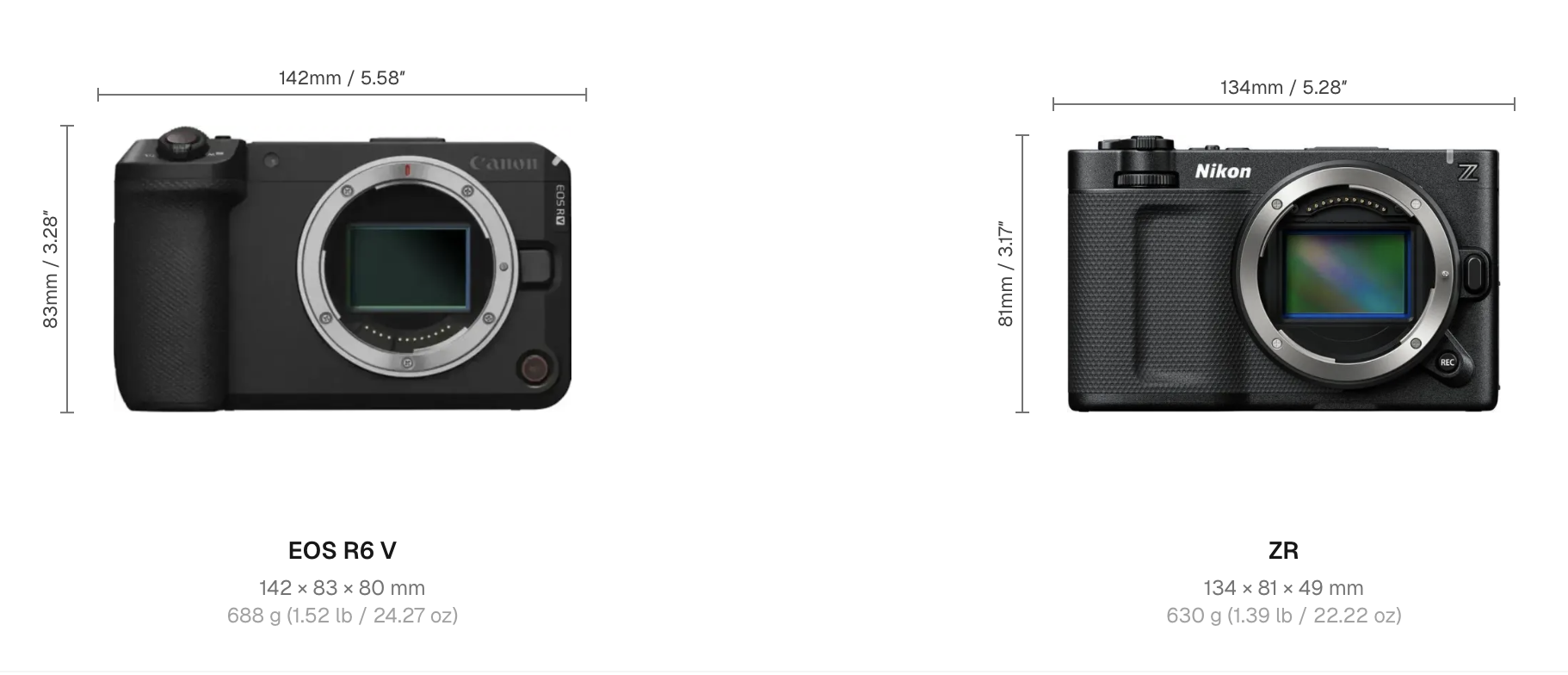
Canon has just announced the new EOS R6 V. Here is a quick comparison of EOS R6 V with Nikon ZR. While both cameras ditch the traditional built-in electronic viewfinder (EVF) in favor of compact, cinema-forward designs, they cater to slightly different creative needs.
Here is a breakdown of how these two powerhouse bodies stack up against each other.
Core Specifications at a Glance
| Feature | Canon EOS R6 V | Nikon ZR |
| Launch Price | $2,499 | $2,199 |
| Resolution | 32.5 MP | 24.5 MP |
| Max Video Resolution | 7K RAW / 7K Open Gate | 6K RAW |
| Max 4K Frame Rate | 120 fps | 120 fps |
| Electronic Burst Speed | 40 fps | 120 fps |
| In-Body Stabilization | 7.5-stop | 7.5-stop |
| Weight | 688 g | 630 g |
Why Choose the Canon EOS R6 V?
Launching at $2,499, the Canon EOS R6 V positions itself as a higher-resolution, video-first powerhouse that doesn’t completely abandon traditional photography mechanics.
-
Superior Resolution: With a 32.5 MP full-frame sensor, it offers 33% more pixels than the Nikon ZR, making it significantly better for cropping and capturing fine details.
-
Advanced Video Capabilities: It steps up the cinema game by offering uncropped 4K DCI/UHD at 120p, alongside massive 7K RAW 60p and 7K Open Gate recording.
-
Active Cooling: Built-in active cooling ensures that filmmakers can shoot long-form content without the constant fear of overheating.
-
Mechanical Shutter: Unlike the ZR, the R6 V retains a mechanical shutter capable of 12 fps, making it a highly capable tool for traditional sports and wildlife shooters.
Pros: 7K Open Gate recording, uncropped 4K/120p, active cooling, dual card slots (CFexpress + SD UHS-II), and Dual Pixel CMOS AF II.
Cons: No built-in EVF, no battery grip support, and a chunkier frame (80mm depth).
Why Choose the Nikon ZR?
Coming in $300 cheaper at $2,199, the Nikon ZR is a hyper-compact cinema rig deeply integrated with RED’s industry-standard color and compressed RAW ecosystems.
-
Cinema-First Ecosystem: Following Nikon’s acquisition of RED, the ZR brings powerhouse internal codecs to a compact body, including R3D NE, N-RAW, and ProRes RAW HQ.
-
Blazing Electronic Speeds: While it completely lacks a mechanical shutter (0 fps), its electronic shutter can capture mind-boggling bursts of up to 120 fps at 24.5 MP.
-
Pro Audio: It features internal 32-bit float audio recording, allowing filmmakers to capture pristine sound with massive dynamic range without worrying about audio clipping.
-
Ultra-Compact Form Factor: Weighing just 630g and measuring a mere 49mm in thickness, it is significantly slimmer and lighter than the Canon, making it perfect for gimbal and drone work.
Pros: 6K/60p RED R3D NE RAW, 32-bit float audio, incredibly compact 535g (body only) footprint, and 120 fps electronic burst.
Cons: No built-in EVF, cinema-first ergonomics that may alienate stills photographers, and a mismatched CFexpress + MicroSD card workflow.
The Verdict: Which One Should You Buy?
Your choice ultimately depends on whether you view yourself as a hybrid creator or a dedicated indie filmmaker:
-
The Canon EOS R6 V is the ideal choice for creators who still want a foot in the photography world. Its higher 32.5 MP resolution, mechanical shutter, and robust wildlife tracking (scoring a perfect 10/10 in algorithmic use-case tests) make it a superior cross-disciplinary hybrid.
-
The Nikon ZR is a dream come true for dedicated videographers and cinema shooters. If you want RED-level raw video performance, 32-bit float audio, and a lightweight body that easily balances on a rig, the Nikon ZR offers unmatched cinematic value for its price.
You can take a look at full Size & Specs comparison of EOS R6 V and Nikon ZR here.