
Olympus has announced its new OM-D E-M1 interchangeable lens camera, which is now the flagship of its Micro Four Thirds lineup. Rather than calling it the follow-up to the E-M5, Olympus says that the E-M1 is actually the ‘successor’ to the E-5, a Four Thirds DSLR introduced back in 2010.
The E-M1’s 16.3-megapixel Live MOS sensor has on-chip phase detection, which promises to focus legacy Four Thirds lenses (using the optional MMF-3 adapter) at much faster speeds than previous Olympus m4/3 cameras.
Other interesting features include the E-M1’s large electronic viewfinder, which has a magnification of 1.48X, a touch-enabled LCD, a rugged body that is water, dust, and freezeproof, and an impressive number of customizable buttons. Wi-Fi is also included.
Price | Where to Buy | Specs | Release Date | Sample Images | Product Images
Olympus OM-D E-M1 Price
Olympus OM-D E-M1 Price – $1,399.00.
Where to Buy Olympus OM-D E-M1
| Store | Buy Now |
|---|---|
| Amazon.com | Buy Now |
| Adorama.com | Buy Now |
| B&H Photo Video | Buy Now |
| ebay.com | Buy Now |
Olympus OM-D E-M1 Features and Specifications
The Olympus OMD E-M1 Micro Four Thirds Camera fills a void left when Olympus quietly shifted its pro and enthusiast camera focus from DSLRs to MILCs. Designed with high-end enthusiasts and professionals in mind, the ruggedly built Olympus OM-D E-M1 shares Olympus’s classic compact OM SLR design elements, adding a more robust feature set including features (some borrowed from the pro-level E-5) and more rugged build than its mid-range sibling, the widely acclaimed Olympus OM-D EM-5.
Designed for Knowledgeable Photographers
The Olympus OM-D EM-1 is rich with features, and is highly customizable. In the hands of a beginner-intermediate photographer it will deliver outstanding results and ease of use via its flip-out touch screen operation, multiple art/scene filters, and iAuto modes, but its strengths will be most appreciated by experienced shooters. It will be of special interest to those understand the utility of multiple, at-your-fingertips HDR settings, custom function assignments to particular buttons, multiple RAW and JPEG image capture options, and lightening-fast autofocus.
In the Hands
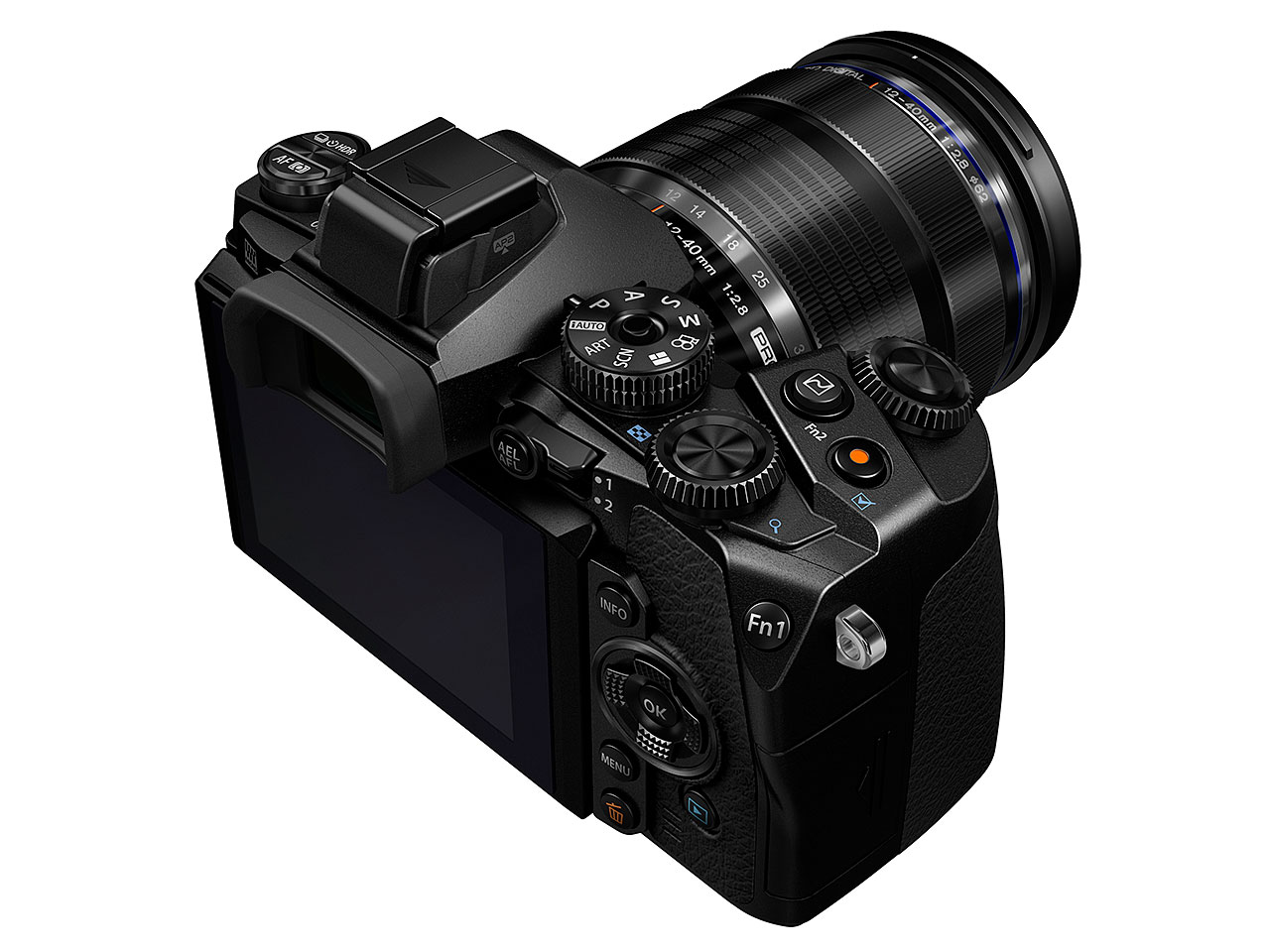
Grasp the Olympus OM-D EM-1 and you’ll immediately notice its substantial grip and build. The EM-1 has a multitude of buttons and controls. The drive /HDR button, located on the left side of the top plate, provides quick access to burst rates and seven flavors of HDR exposure bracketing, including a setting that shoots up to 7 frames with a 2 EV spread or 5 frames with a 3 EV spread.
The bulk of navigation is done via thumb and forefinger dials atop the camera that are within easy reach. There’s a PASM dial that also includes access to iAuto mode, Art filters (12 total, along with an “art Bracket” setting that automatically creates 12 different images with each filter applied) and 24 Scene settings, as well as multi-image montage templates and movie mode.
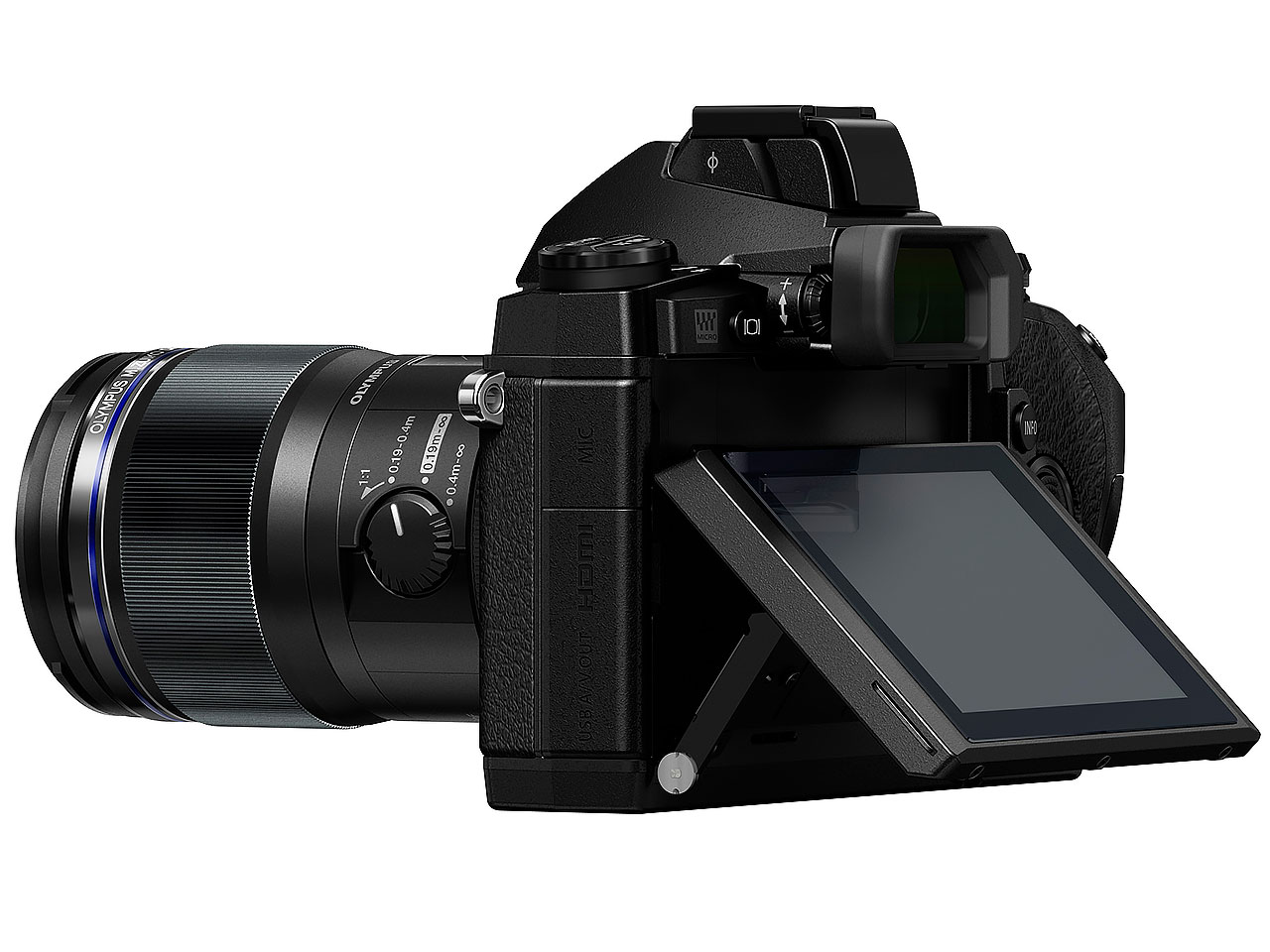
The flip-out LCD monitor offers touch focus (touch the part of the picture you want in focus and it immediately snaps into focus), touch shutter release, etc. I found the LCD monitor to be bright and usable in sunlight. I also give high marks to the eye-level EVF, which projected excellent image quality with barely any “jaggies” when moving the camera.
The EM-1’s convenient articulated LCD monitor lets you place the camera on the ground and compose from a comfortable position.
Favorite Features
Such a feature-packed camera has a mile-long list of capabilities; here are a few favorites that are relatively new for this class of camera, or new to Olympus.
In-camera image editing: Whether you’re shooting JPEG or RAW, the OM-D EM-1 offers several post-processing options, including shadow adjustment, redeye fix, crop, changing the aspect ratio, converting to sepia or black-and-white, adjusting color saturation, or changing resolution. If you shoot RAW, you can apply any number of Art filters after the fact and the camera will generate filtered JPEG images. Very cool!
WiFi: The OM-D EM-1 offers hot-spot connectivity, as well as the ability to load images into your tablet or smart phone, and all Wi-Fi options can be password protected.
Custom settings: A good pro-oriented camera lets you tweak its settings, and the OM-D EM-1 offers plenty of options. Some custom resets include: Changing flash sync from the default to as high as 1/320 sec; an extensive array of white balance choices, Color Balance Bracketing, changing the direction of the focus ring, MF focus peaking or magnification, reassigning functions to 5 different dials and buttons, setting the number of images shot in burst mode, tweaking the shutter release’s sensitivity to pressure, histogram settings, adjusting amount of noise reduction, and changing the ISO setting steps. There are many more options, but this should give you a sense of how extensive and exacting these settings are.
It offers ample customization to meet the needs of particular photographers, and lets you adjust image quality before, during, or after exposure. It has a fast enough burst rate to keep sports photographers happy and thanks to Olympus’s growing line of lenses, enough optic choices to meet a wide range of picture-taking needs for demanding photographers.
| Body type | |
|---|---|
| Body type | SLR-style mirrorless |
| Body material | Magnesium alloy |
| Sensor | |
| Max resolution | 4608 x 3456 |
| Image ratio w:h | 1:1, 4:3, 3:2, 16:9 |
| Effective pixels | 16.3 megapixels |
| Sensor photo detectors | 16.8 megapixels |
| Sensor size | Four Thirds (17.3 x 13 mm) |
| Sensor type | CMOS |
| Processor | TruePIC VII |
| Color space | sRGB, Adobe RGB |
| Color filter array | Primary color filter |
| Image | |
| ISO | 100-25600 in 1/3EV or 1EV increments |
| White balance presets | 7 |
| Custom white balance | Yes |
| Image stabilization | Sensor-shift |
| Image stabilization notes | ‘5-axis’ IS |
| Uncompressed format | RAW |
| JPEG quality levels | Super Fine, Fine, Normal, Basic |
| File format |
|
| Image parameters |
|
| Optics & Focus | |
| Autofocus |
|
| Autofocus assist lamp | Yes |
| Digital zoom | Yes (2X) |
| Manual focus | Yes (with focus peaking) |
| Number of focus points | 81 |
| Lens mount | Micro 4/3 Lens Mount |
| Focal length multiplier | 2× |
| Screen / viewfinder | |
| Articulated LCD | Tilting |
| Screen size | 3″ |
| Screen dots | 1,037,000 |
| Touch screen | Yes |
| Live view | Yes |
| Viewfinder type | Electronic |
| Viewfinder coverage | 100 % |
| Viewfinder magnification | 1.3× |
| Viewfinder resolution | 2,360,000 |
| Photography features | |
| Minimum shutter speed | 60 sec |
| Maximum shutter speed | 1/8000 sec |
| Exposure modes |
|
| Scene modes |
|
| Built-in flash | No (compact external flash included) |
| External flash | Yes (hot-shoe, wireless) |
| Flash modes | Flash Auto, Redeye, Fill-in, Flash Off, Red-eye Slow sync (1st curtain), Slow sync (1st curtain), Slow sync (2nd curtain), Manual |
| Flash X sync speed | 1/320 sec |
| Drive modes |
|
| Self-timer | Yes (2 or 12 secs, custom) |
| Metering modes |
|
| Exposure compensation | ±5 (at 1/3 EV, 1/2 EV, 1 EV steps) |
| AE Bracketing | ±2 (2, 3, 5, 7 frames at 1/3 EV, 2/3 EV, 1 EV steps) |
| WB Bracketing | Yes (3 frames in 2, 4, 6 steps selectable in each A-B/G-M axis) |
| Videography features | |
| Format |
|
| Microphone | Stereo |
| Speaker | Mono |
| Videography notes | 1920 x 1080 (30 fps), 1280 x 720 (30 fps), 640 x 480 (30 fps) |
| Storage | |
| Storage types | SD/SDHC/SDXC |
| Connectivity | |
| USB | USB 2.0 (480 Mbit/sec) |
| HDMI | Yes (micro HDMI) |
| Wireless | Built-In |
| Wireless notes | 802.11b/g/n with smartphone connectivity |
| Remote control | Yes (optional RM-UC1 wired remote) |
| Physical | |
| Environmentally sealed | Yes (Dust, splash, freeze resistent) |
| Battery | Battery Pack |
| Battery description | BLN-1 lithium-ion battery pack |
| Battery Life (CIPA) | 350 |
| Weight (inc. batteries) | 497 g (1.10 lb / 17.53 oz) |
| Dimensions | 130 x 94 x 63 mm (5.13 x 3.68 x 2.48″) |
| Other features | |
| Orientation sensor | Yes |
| Timelapse recording | Yes |
| GPS | None |
Olympus OM-D E-M1 Release Date
The Olympus OM-D E-M1 starts shipping on October 14, 2013.
Olympus OM-D E-M1 Sample Images
See Olympus OM-D E-M1 Sample Images.
Product images & Videos

Thanks for the review. It seems like E-M1 doesn’t have dedicated controls for saving custom settings, similar to what panasonic GX7 has on its main dial (C1, C2, C3). I would assume that these settings are assigned/saved to function buttons. Is this correct? Cheers!